The Building Is the Screen: Inside Britain's Projection Mapping Boom
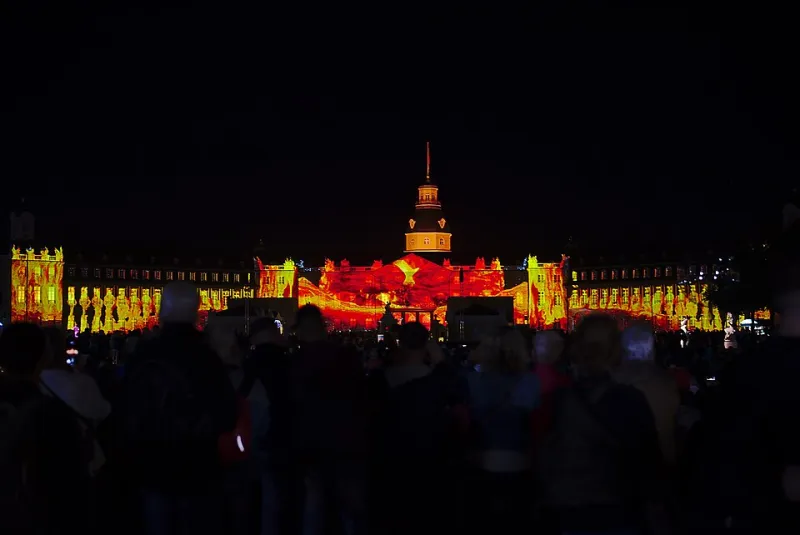
Photo: Flocci Nivis, CC BY-SA 4.0, via Wikimedia Commons
On a Friday night in September, several hundred people stood in a car park in Bedminster, Bristol, watching a 1960s council office block do something a building should not do. Its concrete flank rippled, filled with water, drained, and then — for about ninety seconds — appeared to fall upwards into the sky. Nobody clapped at first. There was that particular hush you get when a crowd is trying to work out how the trick is done.
The answer, more or less, was six projectors, a lot of cable, a laser survey and about four months of work by a four-person collective called Lumen Quarter.
Projection mapping has been a fixture of British festivals and brand launches for well over a decade, but something has shifted in the last few years. The hardware got cheaper and brighter. The software got friendlier. And a generation of artists who cut their teeth in film, animation and motion graphics started looking at the blank cubes of British cities — the gable ends, the plant rooms, the car park stairwells — and seeing screens.
The craft behind the trick
The process starts long before anyone plugs anything in. Most mappers begin with a survey: photographs, a LiDAR scan or a photogrammetry pass, then a 3D model of the facade that becomes the canvas. Content is built to that model, not to a 16:9 frame, which is why mapped work so often feels less like a video and more like a building behaving badly.
On site, the projectors are aligned using a mixture of camera calibration and old-fashioned eyeballing. Screens get stacked. Masks are drawn. Somebody stands in the car park shouting 'left a bit' at a technician on a scissor lift.
'You can have the most beautiful artwork in the world and lose it to a streetlight,' says Niamh Farrelly, a Manchester-based artist who has been mapping onto the city's brickwork since 2021. 'Half of the job is fighting the environment. Ambient light, wet tarmac, a bus shelter, a tree that wasn't there when you recce'd in February.'
Three who are doing it
Lumen Quarter, Bristol. The collective's Bedminster piece, made for a local arts festival, drew on the building's own planning archive — drawings, correspondence, a 1971 photograph of the site before construction. Animation was kept deliberately slow, because, as one member puts it, 'concrete doesn't do fast'. The group's stated aim is to make work that a passer-by can understand in eight seconds without reading anything.
Niamh Farrelly, Manchester. Farrelly works almost exclusively with archive footage, re-photographed and re-timed so that it feels half-remembered. Her ongoing series maps onto a boxy corner of a Victorian warehouse in Ancoats, where the brick provides a natural grid. She describes the building as 'a co-writer' — the rust patches and blocked-up windows dictate where the image can and cannot go.
Tenement Lights, Glasgow. A two-person outfit operating out of a shared workshop in Govanhill, they specialise in community commissions: residents lend family photographs, the pair digitise and animate them, and the result lands on a blank gable end for a single weekend. Their most recent piece, on a 1960s block, drew a crowd that included several of the people whose living rooms were currently being projected forty feet tall.
'There's a moment when somebody recognises their own nan's curtains,' says Tenement Lights' co-founder. 'That's the whole thing. That's the piece.'
Permission is the hard part
The technical side, everyone agrees, is the manageable bit. The paperwork is not.
Mapping onto a building usually requires the owner's consent, and often a temporary event notice, a street works licence if anything touches the public highway, and a conversation with the local authority's conservation officer if the structure is listed or in a conservation area. Road closures need statutory consultation. Anything visible from a distance may attract a comment from aviation or highways. And the insurance conversation about rigging projectors above head height is never brief.
Lumen Quarter describe their first application as 'an education'. They now start the heritage conversation before they start writing the artwork, because a listed facade can rule out mounting points that were central to the idea.
Where it works best, artists say, is where the council is already invested — a high street regeneration scheme, a festival, a town-centre recovery plan. Where it works worst is where a single building owner says no at the last minute, which happens, and which is why most mappers keep a plan B location in their back pocket.
The phone problem
There is a practical tension at the heart of the form: work designed to be seen by a crowd is now almost always watched through a phone. Artists have adapted, some by making pieces that reward a single heroic camera angle, others by going the opposite way — filling the whole facade so that no phone frame can contain it, forcing people to look up.
Audience reaction, by all accounts, remains disproportionately warm. Some of that is novelty. Some of it is simply that it is free, outdoors, and over by ten. In a country where a cinema ticket now costs a small fortune, a building that turns into a film for four nights is a genuinely populist gesture.
Where it goes next
The kit keeps improving. Higher-lumen laser projectors have made larger facades viable; real-time engines have made reactive work much less painful; and the arrival of cheaper LiDAR on phones has democratised the survey stage.
The risk is sameness. Once every town centre has a mapped winter light trail, the trick needs content to carry it, and there is a limit to how many times an audience will be thrilled by a building appearing to fall over.
The artists we spoke to seem aware of this. Tenement Lights are moving towards longer, quieter pieces with live scores. Farrelly is experimenting with work that runs for a full evening and changes as the light fades. Lumen Quarter want to map something that isn't a landmark at all — a substation, a stairwell, a wall nobody has ever looked at.
Which may be the most interesting direction of all. The medium's real offer isn't spectacle. It's permission to look again at the boxes we walk past every day.