The Case Against the Blank Box: Why Awkward Studios Make Better Films
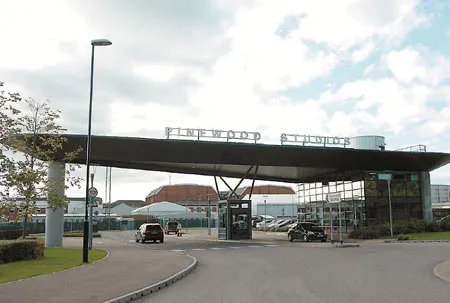
Photo: Unknown authorUnknown author, CC BY 3.0, via Wikimedia Commons
There is a certain kind of studio brochure that tells you everything and nothing. Power: 3-phase. Parking: six spaces. Ceiling height: 6.2 metres. What it doesn’t tell you is whether the room has a personality, or whether it has been sanded down to the point of anonymity. And in my experience, the second detail matters more than the first.
The white box problem
Let’s be clear: a blank box has its uses. If you’re shooting a commercial that needs to look like a commercial shot in a blank box, then a blank box is exactly what you want. But the assumption that every production benefits from a neutral, wipe-clean environment is one of those quiet orthodoxies that deserves a poke. Walk into a studio that has been stripped of its history and you often find the same thing: a space that is technically faultless and emotionally inert.
“We once had a director walk into our main stage and ask if we could remove the old iron column,” says a studio manager at a converted mill in West Yorkshire. “I said we could, but it would take three weeks and a structural engineer. He looked at it again, walked around it twice, and then said, ‘Actually, keep it. It gives me a foreground.’” That is not an unusual story. It is the story of British studios.
What a corner does to a camera
Production designers talk about “blocking” in terms of actors and camera moves, but the room itself is part of the choreography. A pillar forces a decision. A low beam changes a lens choice. A wonky wall makes a lighting setup ask questions rather than simply accept instructions. Those constraints are not obstacles; they are prompts.
“In a blank box, you have to invent the world from scratch,” says a London-based production designer who has worked in both railway arches and purpose-built stages. “That’s fine if you have the budget for a full build. But if you don’t, a room with a bit of texture and a few awkward angles can give you 30 per cent of the design for free. You just have to be willing to collaborate with the building.”
That collaboration is where the good stuff happens. A brick wall that catches the late afternoon sun. A row of high windows that create a natural top light. A set of double doors that let you stage a reveal without rigging a single flag. These are not features you can list on a spec sheet, but they are absolutely features.
Inherited architecture, inherited stories
Britain is unusually good at this because Britain is unusually bad at knocking things down. We have old churches, railway arches, mills, schools, hospitals and warehouses that have been repurposed so many times that their original function is now just a rumour. A studio in a former lemonade factory in Bristol. A soundstage in a Glasgow industrial unit that still has the crane rails in the ceiling. A shoot space in Salford that was once a Wesleyan chapel and still has the organ pipes behind a false wall.
Those spaces carry something. Not in a mystical way, but in a practical one: they have already been used for gathering, working, performing, storing. They have a scale and a rhythm that human beings recognise. When you put actors in them, they behave differently. When you put a camera in them, the frame has depth before you’ve even lit it.
“We get a lot of directors who book us because the building looks like something,” says the manager of a converted chapel in the North West. “They don’t always know what it looks like. They just know it doesn’t look like nothing.”
The practical case for personality
This is not just a romantic argument. Character has operational value. A room with a history often comes with a community around it: the neighbour who knows where the stopcock is, the local cafe that will do a last-minute run, the caretaker who has been there for thirty years and can tell you which wall is load-bearing. That network is a production asset. It saves time. It saves money. It saves the day when the generator fails at 7pm.
It also affects mood. Crews are not machines. Put them in a windowless box for a fourteen-hour day and you get a certain kind of energy. Put them in a room with a bit of daylight, a bit of texture and a bit of local history and you get a different one. The work is still hard, but it feels like it is happening somewhere rather than nowhere.
When character becomes a cost
None of this is an argument for every studio to be a crumbling listed building with a leaky roof. Character has a price. Old buildings are harder to black out, harder to heat, harder to insure. A wonky floor is charming until it isn’t. A pillar that gives you foreground also gives you a blind spot. The best studio managers are honest about this: they will tell you what the building can do and what it can’t, and they won’t pretend a quirk is a feature if it’s actually a liability.
But the conversation needs to shift. When a producer lists requirements, “personality” rarely makes the list. It should. Not because every shoot needs a church hall or a railway arch, but because the assumption that a blank box is the safe choice is often wrong. The safe choice is the room that gives you options. Sometimes that room is a blank box. Sometimes it is a former lemonade factory with a stubborn column and a story in every wall.
Britain’s best studios aren’t blank boxes. They are buildings with opinions. And the work that comes out of them is usually better for it.