The Wall That Isn't There: Keeping a British Cyclorama Honest
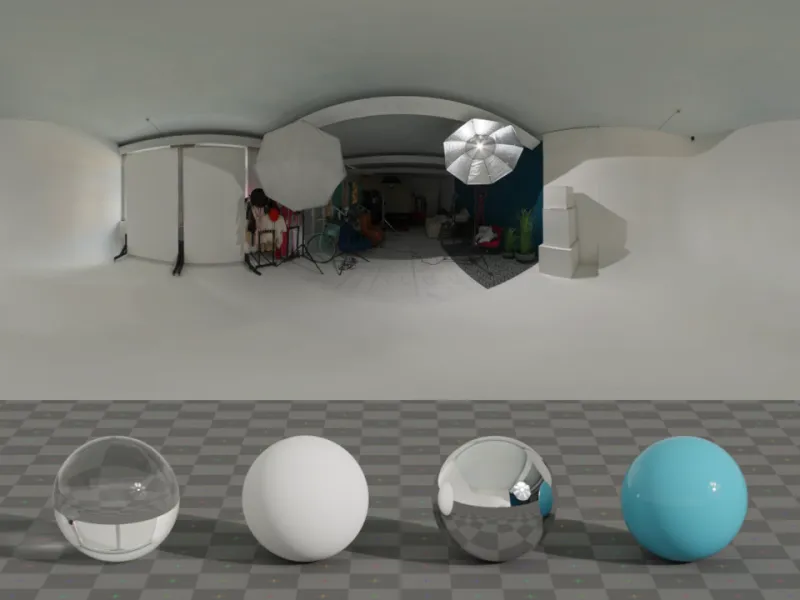
Photo: Sergej Majboroda (https://polyhaven.com/all?a=Sergej%20Majboroda / https://web.archive.org/web/20230623180233/https://polyhaven.com/all?a=Sergej%20Majboroda) via Poly Haven, CC0, via Wikimedia Commons
A cyclorama is the quiet overachiever of the British studio. It does not move. It has no buttons. It will not send anyone a calendar invite. Yet the moment a director wants a car to float in nothingness, a dancer to spin into white, or a ceramic bowl to look like it is hovering in an ad man's dream, everyone turns to the same curved wall at the back of the room.
The cyc — short for cyclorama, because studio life is built on abbreviations — is essentially a seamless corner. Wall meets floor through a gentle cove rather than a hard right angle. Get it right and the eye stops reading the room. Get it wrong and the shot looks like a school hall with a sheet pinned up. The difference is rarely glamorous. It is plaster, paint, tape, track and a studio manager with a torch, squinting at a shadow.
First, the geometry
Most British cycs are built rather than bought. In a converted warehouse in Bristol or a former print works in Leeds, the wall often starts as timber studwork faced with plywood or plasterboard, then skimmed and sanded until the curve feels continuous. Some studios use prefabricated cove sections; others trust a carpenter, a chop saw and a great deal of patience. The radius matters. Too tight and the curve reads as a bend; too generous and you lose floor space you cannot afford in a city where every square metre has a rent attached.
The floor is part of the illusion. A true cyc usually runs into a painted floor that can be repainted, patched and repainted again. Studios lay down hardboard or MDF over the existing floor, seal the joints, and cover the lot in a matte white or grey. The join between wall and floor is not a join at all — or at least it should not be. That is the whole trick. The wall is not there to be looked at. It is there to disappear.
The white that isn't one white
Ask five studio managers what colour their cyc is and you may get five answers: white, off-white, super-matte white, that-white-we-used-last-time, and please-don't-touch-it white. The paint choice is a small obsession. Gloss is out. Eggshell is risky. A good cyc paint is flat enough to swallow light without going chalky, and durable enough to survive a week of stands, cables and people in hard shoes.
British studios tend to repaint more often than they would like. A music video might leave behind tyre marks. A product shoot might leave a forest of tiny tripod scratches. An art project might leave something conceptual and difficult to explain to the next client. The wall gets touched up in sections, feathered out with a roller, and given time to dry. If you have ever stood in a studio at 7am watching a runner paint a white wall white, you have seen the real infrastructure of the creative industries.
Lighting the lie
The cyc is not really an infinity screen. It is a curved surface that responds to light, and lighting it well is a craft in itself. A gaffer will often wash the wall with soft, even sources — large softboxes, bounced daylight, or a row of spacelights — to remove hotspots and keep the background reading as one continuous field. The floor needs its own attention. Light it too much and it glares; light it too little and the curve goes muddy.
Then there is the question of spill. White walls bounce light everywhere, which is lovely for faces and terrible for control. Flags, cutters and black cloth become part of the choreography. A good cyc shoot is not just a camera pointed at a wall. It is a small negotiation between the subject, the surface and the shadows that neither party wants to admit are there.
When the curve gets bruised
A scuffed cyc is not a disaster, but it is a talking point. Studios develop house rules: no street shoes on the floor, no gaffer tape left overnight, no leaning flight cases against the curve. The wall is both blank canvas and fragile character. It can take a knock, but it cannot hide one. A dent in the cove shows up in a wide shot like a bruise on a peach.
Repairs are part of the rhythm. Small marks get touched in. Larger dents get filled, sanded and repainted. If the damage sits right on the curve, the repair has to be blended carefully or the camera will find it. Studio managers become oddly attached to their cycs. They know which corner catches the light, which patch dries slightly differently, and which visiting crew will pretend not to notice the sign asking them to keep drinks off the floor.
A character with a temper
What makes the cyc interesting is that it is never quite neutral. It changes with the weather, the heating, the age of the paint and the mood of the lighting rig. A wall that looked flawless on Monday can look tired by Thursday. A fresh repaint can be too bright for a scene that wanted softness. A grey cyc can read warm under tungsten and cold under LED. The surface is supposed to erase itself, but it has opinions.
That is why so many British studios treat the cyc as a piece of kit rather than decoration. It needs maintenance, a budget line, and someone who notices when the curve has lost its smoothness. It also needs protecting from the very people it serves: the crews who arrive with stands, shoes, smoke machines and ambitious ideas.
Why it still earns its corner
In an age of virtual production, LED volumes and digital extensions, the humble cyc has not gone anywhere. It is too useful. It is cheap compared with a wall of screens, quick to reset, and honest about what it does. It gives a director a clean plate, a photographer a soft field of light, and an artist a surface that can be lit into near-nothingness. It is the studio equivalent of a good plain wall — except this one curves, costs more to maintain, and has a habit of making everyone look clever.
So the next time a shot feels beautifully limitless, look for the seam. There probably isn't one. Behind that absence is a carpenter, a painter, a gaffer, a studio manager and a wall that has been sanded, sealed and sworn at. The infinite curve is not magic. It is maintenance — and in Britain's studios, maintenance is where the magic quietly lives.