The Lattice Overhead: How a Studio Ceiling Earns Its Keep
You walk into a studio and your eyes go to the floor. Then the walls. Maybe the cyc. Almost nobody looks up. Which is a shame, because the ceiling grid is doing most of the quiet work.
The Skeleton Overhead
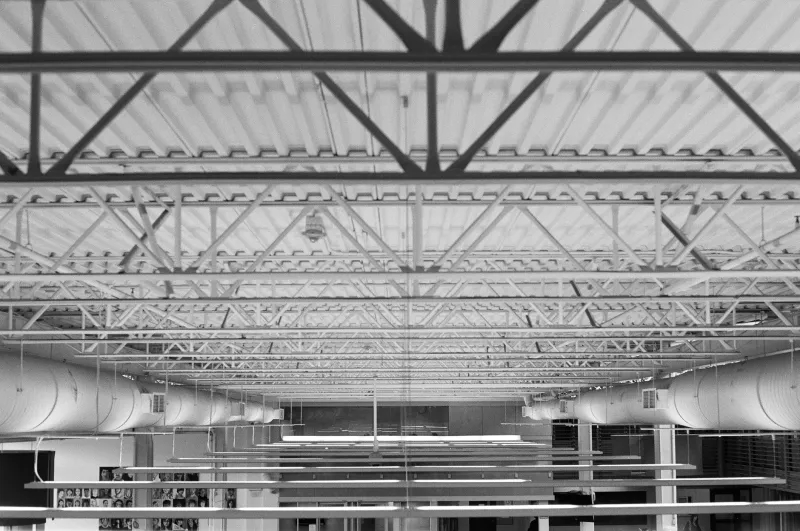
A ceiling grid is not really a ceiling. It is a skeleton. Steel or aluminium bars fixed at regular centres — often a metre or so apart — suspended from roof trusses or purpose-built beams. In older British warehouses it is tied into the original steelwork, with load calculations filed somewhere sensible. In newer builds it is engineered in from the start. Either way, it is infrastructure, not decoration.
People confuse it with a lighting truss on ground support. They are cousins, not twins. A ground-support truss is temporary and self-contained. A permanent grid is part of the building. It stays put, it gets inspected, and it carries the weight of everyone else's good ideas.
Load Limits and the Art of Saying No
Every grid has a safe working load. That might be a figure per point — often somewhere between 100kg and 250kg, depending on the building — and a total capacity for the room. The distinction between a point load and a distributed load matters. A single 2kW Fresnel is not heavy. Add a moving head, a ballast, a softbox, a cable loom and a bracket, and the number creeps up. Add a person climbing the wrong bit of steel, and it stops being a calculation and becomes a conversation with the Health and Safety Executive.
Good studio managers are firm about this. They will ask what you are hanging, where, and how much it weighs. They will not let you clip to a sprinkler pipe, a cable tray or a roof purlin just because it looks sturdy. They will point you at the marked points and the inspection log. Under LOLER, lifting equipment gets a thorough examination by a competent person at least annually, plus pre-use checks. The log lives in a plastic wallet in the office, and it is the first thing a visiting production manager asks for.
The Most Flexible Tool in the Room
Here is the argument. In a tight UK studio, floor space is premium. Walls are fixed. The cyc is where it is. But the ceiling is free real estate. A 200 square metre studio with a five-metre grid has 200 square metres of usable air above your head.
Need a soft overhead for an interview? Hang a large diffuser and bounce. Need a hard key from the left rather than the right? Move the point, not the set. Need to kill a reverberant slap from a low ceiling? Hang acoustic clouds or molleton. Need to change the mood between setups? The grid lets you do it with a ladder and a spanner rather than a builder and a skip.
That is why the ceiling is often the most creative tool in the room. It is not glamorous. It does not appear in the mood board. But it is the difference between a space that adapts and a space that dictates.
Rigging Etiquette: The Unwritten Rules
Every studio has them. Leave the grid as you found it. Label your cables. Do not cross another crew's points without asking. Book your hanging positions before you arrive, not after. Use safety bonds. Do not gaffer-tape a 10kg light to a bar and call it rigging. The grid is shared infrastructure, so treat it like a communal kitchen: clean up, do not hog the good spot, and do not leave a mess for the next person.
There is also a quieter rule. If you are not sure, ask. A rigger who says 'I will check' is worth ten who say 'it will be fine'.
The Inspection Log Nobody Reads Until They Need It
Grid inspections are not glamorous work. Someone checks welds for corrosion, bars for bends, pins for wear, cables for stretch. They look at the fixings into the building. They note anything that has changed since last time. A grid that fails inspection is a room that stops earning, so the boring paperwork is cheaper than a shutdown.
For visiting crews, the log is reassurance. For the studio, it is a licence to keep working. It is also a reminder that the ceiling is a piece of engineering, not a magic shelf.
Look Up
British studios are often tight, awkward, listed or all three. The grid is how you make a small room bigger without building an extension. It is how you move a light without moving a wall. It is how you turn a warehouse into a soundstage and back again before lunch.
Next time you are on a set, look up. The ceiling is not blank. It is a toolkit.