Shelf Life: The Warehouses Where Cinema's Oddest Objects Wait for Their Close-Up
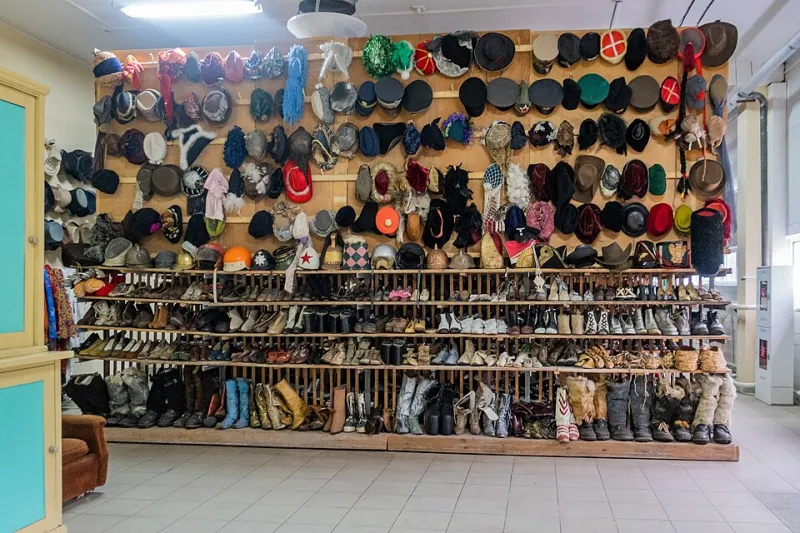
Photo: Homoatrox, CC BY-SA 3.0, via Wikimedia Commons
There is a unit on an industrial estate somewhere in the home counties that smells of dust, cold metal and, faintly, mothballs. The lights are on a motion sensor. Down the central aisle, past a rack of Bakelite telephones, sits a glass-fronted cabinet containing forty-odd glass eyes.
This is not a museum. Nothing here is precious in the way a museum means it. Everything is for hire, and has probably been sat on by an actor at some point.
The unglamorous engine room
Prop houses are the part of the supply chain that never makes the poster. A production's art department will spend months building a world from scratch, and then fill its gaps from places like this — rental libraries that hold the strange, the obsolete and the slightly alarming, ready to be booked by the week and returned with a condition report.
"Nobody grows up wanting to run a prop house," says the owner of one such library, who has been accumulating objects since the late 1990s. "You start as a maker, or a buyer, and then you realise you can't throw anything away, and then suddenly you need a bigger unit."
That accumulation is the business model. When a drama needs a 1970s hospital trolley, a taxidermy fox in a glass case, or a working rotary phone that can be wired for a practical ring, there isn't time to source it from scratch across three counties. There is time to drive to a warehouse that already has six of them.
How you stock a fictional world
The sourcing is where the stories live. British prop buyers work house clearances, country auctions, closing-down sales of dental surgeries and school science departments, and the occasional deceased estate where the contents turn out to be more interesting than the property. Charity shops, car boot sales, online marketplaces at two in the morning — all fair game.
Then there's the stranger trade: makers who specialise in deliberate oddities. A hand-built Victorian contraption that never existed but looks like it should have. A fictitious brand of cereal with a convincing vintage packet. Items that solve a script problem by pretending to be antiques.
Some categories come with legal baggage. Taxidermy is subject to wildlife and animal-welfare rules that vary by species and by age, and a hirer needs to know that the piece in front of them has appropriate documentation. Deactivated firearms, antique medical instruments, anything with a blade still in it — all of it needs paperwork that follows the object out of the door and back again.
Electrics are their own quiet nightmare. A production might want a 1960s television that actually switches on, or a desk lamp that has to be practical on camera. Safety testing, PAT certificates and the occasional discreet conversion to modern internals are standard parts of the job. The trick is doing it without destroying the patina that made the object worth having in the first place.
The strange inventory
Ask three prop houses what their oddest item is and you'll get three long, slightly competitive answers. A mechanical puppet used in a 1980s children's series. A full set of dental chairs. A shipping crate of unlabelled laboratory glassware. Faux medieval armour cast for a production and then quietly rented out for twenty years.
"We have a shelf of things that have never been hired," one warehouse manager admits. "They're not for hire, really. They're just ours."
That sentiment is common. Prop libraries sit somewhere between business and archive, and many of them hold objects of genuine documentation value — the actual tools of a trade that has since been digitised, the branded packaging of products that no longer exist. The British film industry's collective memory is, in part, a series of climate-controlled containers in Slough.
The paperwork behind the magic
Hiring is deceptively bureaucratic. A rental agreement specifies dates, replacement value, insurance responsibility and the condition of each item on the day. Photos at collection, photos at return, a signed note about the scuff that was always there. Productions lose and break things; prop houses build that into the pricing.
Clearance is the other trap. A recognisable branded product can't be shown without permission, which is why art departments spend so much time obscuring labels and inventing fake ones. A prop house holding genuine vintage packaging has to be careful about how that object is used and where it appears. The best facilities have conversations with hirers before the object leaves the shelf, not after legal gets involved.
And there is the matter of continuity. When a film shoots out of order across six weeks, the same object has to come back in the same condition, more than once. Prop departments log everything. A broken handle in week two becomes an inconvenient plot point in week five.
Why physical still wins
Virtual production has changed the conversation but not settled it. LED volumes can render a horizon beautifully, and CGI can conjure objects no warehouse could store. What neither does especially well is give an actor something to do with their hands.
"Give a performer a real object and the performance changes," says one props master who has worked across UK television and feature work. "They lick it, they drop it, they get fingerprints on it. The camera sees weight. You can't fake the way light behaves on chipped enamel."
There's a practical argument too. A physical prop needs no tracking, no match-moving, no artist chasing reflections across a plate. For anything in close-up or in contact with a performer, the cheap option is often the real one.
The quiet economics of not throwing things away
Prop libraries are, almost by accident, one of the more sustainable corners of the industry. Every object hired is an object not manufactured for a single shoot and then skipped. Every warehouse aisle is a small rebuke to the disposable production model.
The margins, though, are thin. Storage in the south-east is expensive, and objects that sit idle for two years are a cost rather than an asset. Several smaller libraries have folded or consolidated into bigger ones during the past decade. What survives tends to be the specialist — the place you ring because nobody else has a taxidermy heron and a working reel-to-reel.
So the next time a drama sells you a world so convincing you forget to look at the scenery, spare a thought for the aisle it came from. Somewhere, a motion sensor has just clicked on, and a warehouse manager is filling in a condition report by torchlight.